The “Forever Renter” Era: What It Means for Today’s Landlords

More Americans are renting longer than ever before, and many are becoming lifelong renters. With homeownership increasingly out of reach for a large portion of the population, the rental market is shifting in ways that directly affect landlords. Understanding these changes can help property owners plan more effectively and make smarter long‑term decisions.

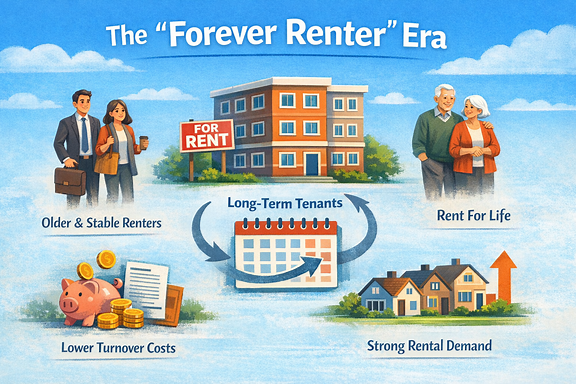
Homeownership has become harder to achieve due to rising prices, limited inventory, and economic pressures. As a result, many renters who once expected to buy a home eventually are now staying in the rental market indefinitely. This creates a larger and more stable pool of long‑term tenants.

Today’s renter is also older and more settled than the stereotype suggests. The renter population now includes mid‑career professionals, families seeking stability, and older adults who prefer the convenience of renting over the responsibilities of owning a home. These groups tend to stay longer, pay reliably, and value consistency, which can be a major advantage for landlords.

Longer tenancies translate into lower turnover costs. Every move‑out requires cleaning, repairs, advertising, and time without rent. When tenants stay for several years instead of one, landlords save money and enjoy more predictable income. Reduced turnover is one of the most significant financial benefits of the “forever renter” trend.

This shift also strengthens the long‑term outlook for rental housing. If renting becomes a lifelong norm for more households, demand for well‑maintained rental units will remain strong. Landlords who invest in their properties and provide a good living experience are likely to see stable occupancy and steady rent growth over time.

The “forever renter” era represents a structural change, not a temporary trend. For landlords, it offers a more stable tenant base, fewer turnovers, and stronger long‑term demand. Those who adapt to the needs of long‑term renters and maintain quality housing will be well positioned to benefit from this new reality.

Know the Rules: Tenant Screening in Massachusetts

If you’re a landlord in Massachusetts, tenant screening is a key part of managing your rentals. But unlike in many other states, the rules here are strict and designed to protect applicants while still allowing you to vet prospective renters effectively. Knowing what the law allows and prohibits can help you avoid legal trouble and screen consistently and fairly.

No Application or Screening Fees
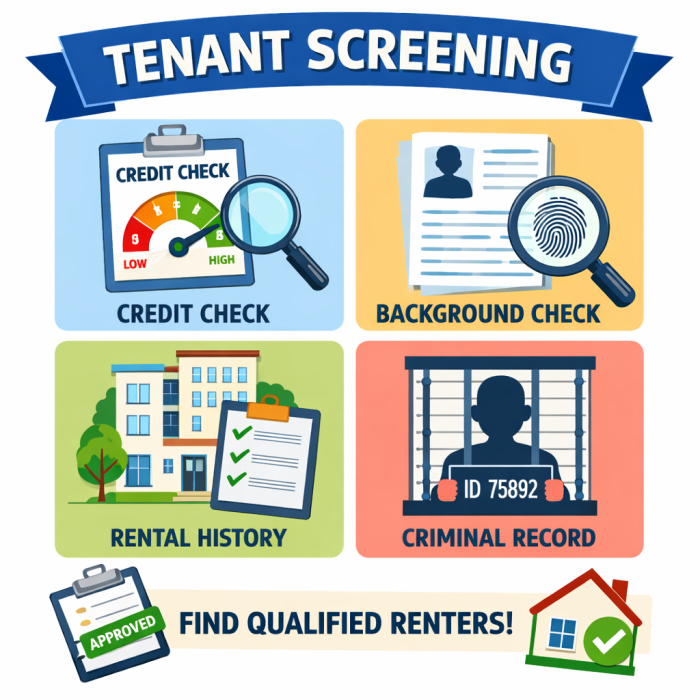
One of the most important points in Massachusetts tenant screening law is that landlords cannot charge rental application fees or screening fees before a lease is signed. This means you cannot require applicants to pay for things like:

  • Credit checks

  • Background checks

  • Application processing fees

This prohibition is part of state law, and landlords must absorb these screening costs themselves or use screening services that the applicant chooses and pays for independently. Massachusetts and Vermont are currently the only states with this kind of outright ban on application fees.

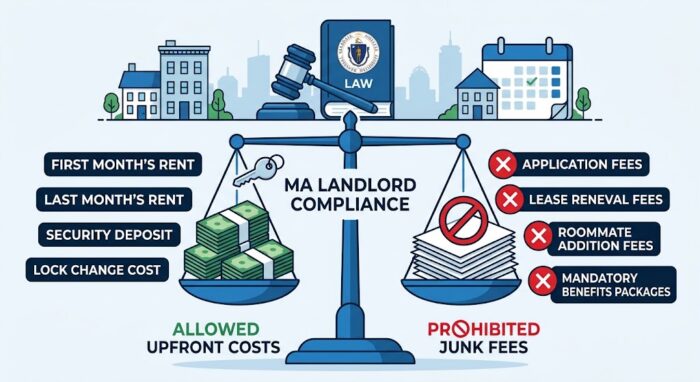
State law does allow certain charges at the start of a tenancy, such as:

  • First month’s rent

  • Last month’s rent

  • Security deposit (within legal limits)

But nothing that functions like an “application fee” can be imposed before a formal rental agreement is in place.
Source of Income Protections

Massachusetts goes beyond federal fair housing protections by making source of income a protected category. That means you cannot refuse to rent to someone simply because they use a lawful source of income, such as:

  • Housing Choice Vouchers (Section 8)

  • Social Security or disability benefits

  • Child support or retirement income

These protections are enforced through the Massachusetts Commission Against Discrimination (MCAD), and discriminating based on income source could violate state fair housing law.

Criminal Background Screening
Massachusetts does not have a specific state “Fair Chance Housing” law, but federal fair housing requirements still apply. This means:

  • You can consider criminal history, but you cannot use arrest records alone to deny an application

  • Blanket bans on all convictions may violate federal guidance

  • You should evaluate the relevance of a conviction and how long ago it occurred

Federal guidance (from HUD) encourages individualized assessments to avoid discriminatory impacts.

Fair Housing Compliance
In addition to the federal protected classes (like race, color, religion, familial status, and disability), Massachusetts law adds protections for:

  • Source of income

  • Receipt of public assistance

  • Sexual orientation and gender identity

  • Marital status

  • Age

  • Genetic information

  • Military or veteran status

These broader protections mean landlords need to be especially careful that screening criteria and practices are applied equally to all applicants.

Best Practices for Compliant Screening
To stay on the right side of the law while still making smart tenant decisions:

  • Document your screening criteria before you list a unit

  • Apply the same standards to every applicant

  • Absorb all screening costs yourself or accept applicant-provided reports voluntarily

  • Avoid any fee that looks like an application or processing charge

  • Train staff or anyone helping you screen to follow fair housing rules strictly

Being consistent and transparent in your screening process not only helps you find good tenants, it also protects you if a complaint is ever filed.

Top 5 Things You Need to Know as a Massachusetts Landlord in 2026

With housing laws and regulations constantly evolving in Massachusetts, staying informed has never been more important for landlords. From eviction record sealing and tenant screening to Mass Save energy incentives and new opportunities like accessory dwelling units (ADUs), these updates can directly affect how you manage and protect your rental properties.

Originally published last year, this article from MassLandlords.net is still highly relevant for 2026. It walks through the top five issues every Massachusetts landlord should know and offers practical, actionable tips you can actually put to use.

MassLandlords.net is a trusted nonprofit that keeps landlords informed with education, advocacy, and up-to-date legal resources specifically tailored for Massachusetts property owners.

Take Action to Stop Rent Control in Massachusetts

Take Action to Stop Rent Control in Massachusetts

Rent control is heading for the 2026 ballot and its return could seriously affect small landlords and rental housing across the state. NWCLA members can make a difference by supporting our partner association, MassLandlords.net who is taking the lead in rallying against this proposal.

Spread the Word
Rent control does not work. When Massachusetts tried it before, the people who needed help most did not benefit while others who did not need it did. Buildings fell into disrepair or were abandoned and rental availability dropped. There is a reason it was voted out and we need to make sure it does not come back.
Visit rentcontrolhistory.com to learn the real history and share it with your networks.

Donate to Protect Property Rights
Fighting rent control is not cheap. Even a small tax-deductible donation, around one percent of monthly rent receipts, helps MassLandlords campaign against rent control, defend small landlords, and protect rental housing across Massachusetts.

NWCLA will be collecting donations for this effort at the December 11 Holiday Social. Please come ready to contribute, the association will be matching donations dollar for dollar up to the designated maximum.

Do not leave the future of rental housing to chance. Spread the word, donate, and take a stand today.

Not a member? Join Here

Rent Control in Massachusetts: Lessons from the Past and Why It Won’t Work Now

As Massachusetts faces rising housing costs, some have proposed rent control — government-imposed limits on rent increases — as a way to make housing more affordable. However, history and research show that rent control is unlikely to solve the problem, and may even make it worse.
A Look Back: Rent Control in the 1970s
Massachusetts first experimented with rent control in the 1970s in cities like Boston, Cambridge, Somerville, Brookline, and Lynn. The results were problematic:
  • Rental unit numbers declined by 8–12%, and property values dropped.
  • Rent-controlled buildings fell into disrepair because landlords could not afford maintenance.
  • New construction stalled, leaving cities with thousands of vacant or unusable properties.
  • Many units were occupied by higher-income tenants rather than low-income households.
By the mid-1980s, these negative effects led to a repeal of local rent control policies in 1994.
Why Rent Control Fails Today
Research consistently finds that rent control leads to:
  1. Reduced Housing Supply: Developers and landlords are discouraged from building or maintaining rental properties when future rents are capped.
  2. Lower Housing Quality: With rental income limited, landlords have fewer resources to maintain or upgrade properties, which can further depress property values.
  3. Limited Benefits for Those Most in Need: Rent-controlled units often go to higher-income tenants, reducing mobility and leaving the most vulnerable renters without affordable options.
Studies in cities like San Francisco, New York, and St. Paul, MN, have shown that rent control can even increase overall rents due to reduced supply and competition for remaining units.
Better Alternatives
Instead of repeating past mistakes, Massachusetts should focus on policies that encourage new housing construction and maintain quality. Proposals on the 2026 ballot could allow cities to reduce minimum lot sizes for single-family homes, opening opportunities for more affordable housing. Polls show that a strong majority of Massachusetts voters support these approaches.
Conclusion
Rent control is not a silver bullet. It risks shrinking housing supply, reducing quality, and making housing less accessible for those who need it most. Massachusetts’ best path forward is to incentivize development, improve existing housing, and adopt policies that increase affordability without the unintended consequences of rent control.

Credit: Mass Opportunity Alliance, “Deep Dive: Rent Control Didn’t Work in the ‘70s and It Won’t Work Now,” September 26, 2025
Link to original article: https://massopportunity.org/content/blog/deep-dive-rent-control-didnt-work-in-the-70s-and-it-wont-work-now/

What Landlords Should Know About Immigration Enforcement

Dealing with immigration enforcement can be confusing for landlords, so it helps to know your rights and responsibilities. The National Apartment Association (NAA) recently provided guidance for property owners on this topic.
First, landlords are not required to enforce immigration laws or check a tenant’s immigration status. Your main role is to manage your property and follow housing laws.
Tenants also have rights that need to be respected. They are entitled to privacy and protection from discrimination based on immigration status. This means you should treat all tenants the same, regardless of where they’re from or their legal status.
If immigration officers come to a rental property, they generally need a judicial warrant or the tenant’s consent to enter a unit. Administrative documents from ICE alone usually don’t give them the legal right to access a rental unit.
Landlords may choose to cooperate with authorities, but any cooperation must comply with applicable laws. This includes being careful about sharing tenant information or allowing access without proper authorization. Consulting legal counsel before taking action is always a good idea.

The bottom line is that landlords should focus on following housing and privacy laws while staying informed about their rights. NAA’s guidance is a helpful resource for understanding how to handle requests from immigration authorities safely and legally.

Assistance Animals in Massachusetts Housing

In Massachusetts, both federal and state laws protect the rights of tenants with disabilities who need assistance animals. These animals can include trained service animals—like guide dogs—or emotional support animals (ESAs) that help with mental health conditions. Even if you have a “no pets” policy in your rental property, you may be required to allow these animals as a reasonable accommodation.

One important distinction is that assistance animals are not considered pets under the law. Because of this, landlords cannot charge pet deposits, fees, or extra rent for them. Tenants, however, remain responsible for any damages their animal causes, just as they would for damage from a guest.

Landlords have the right to request documentation when the need for an ESA is not obvious. Typically, this comes in the form of a letter from a licensed healthcare provider. This letter does not need to disclose a diagnosis, but it should confirm that the tenant has a disability and explain how the animal helps them. Online “registries” or certificates alone are not considered legitimate proof.

There are only limited reasons a landlord can deny an assistance animal request. You cannot refuse based on the animal’s size, breed, or general assumptions. Denial is only allowed if you can show specific evidence that the animal poses a direct safety threat or would cause significant property damage. Even then, you are expected to consider whether the tenant can take steps to correct the issue before moving toward removal.

Tenants also have responsibilities. Assistance animals must be properly licensed and vaccinated according to local rules, kept under control (such as leashed in common areas), and maintained in a way that doesn’t disturb neighbors. Issues like excessive noise, aggression, or failing to clean up after the animal can be addressed, but landlords should approach these situations carefully and fairly.

If disputes arise, both landlords and tenants can reach out to the Massachusetts Office on Disability (MOD) for guidance. Tenants who believe their rights are being violated may also file a complaint with the Massachusetts Commission Against Discrimination (MCAD) or with HUD at the federal level.

Understanding these rules helps landlords stay compliant while also building positive relationships with tenants. By treating assistance animal requests seriously and respectfully, landlords can avoid legal pitfalls and support tenants who rely on these animals for their daily wellbeing.

Adapted from “Assistance Animals in Housing”, Massachusetts Office on Disability / Mass.gov.

Source: Mass.gov – Assistance Animals in Housing

Broker Fee Ban” Signed into Law via Budget; Zillow Application Fees Apparently Banned

Legislators and media allies are taking credit for a “broker fee ban,” which passed into law as part of the state budget July 4, 2025. We’ll show how this “ban” only changes how costs land on renters. To echo one journalist we spoke with, “This is more complicated than I thought.” Brokers and landlords should be able to comply with minimal changes to process. Zillow will have to make substantial changes.
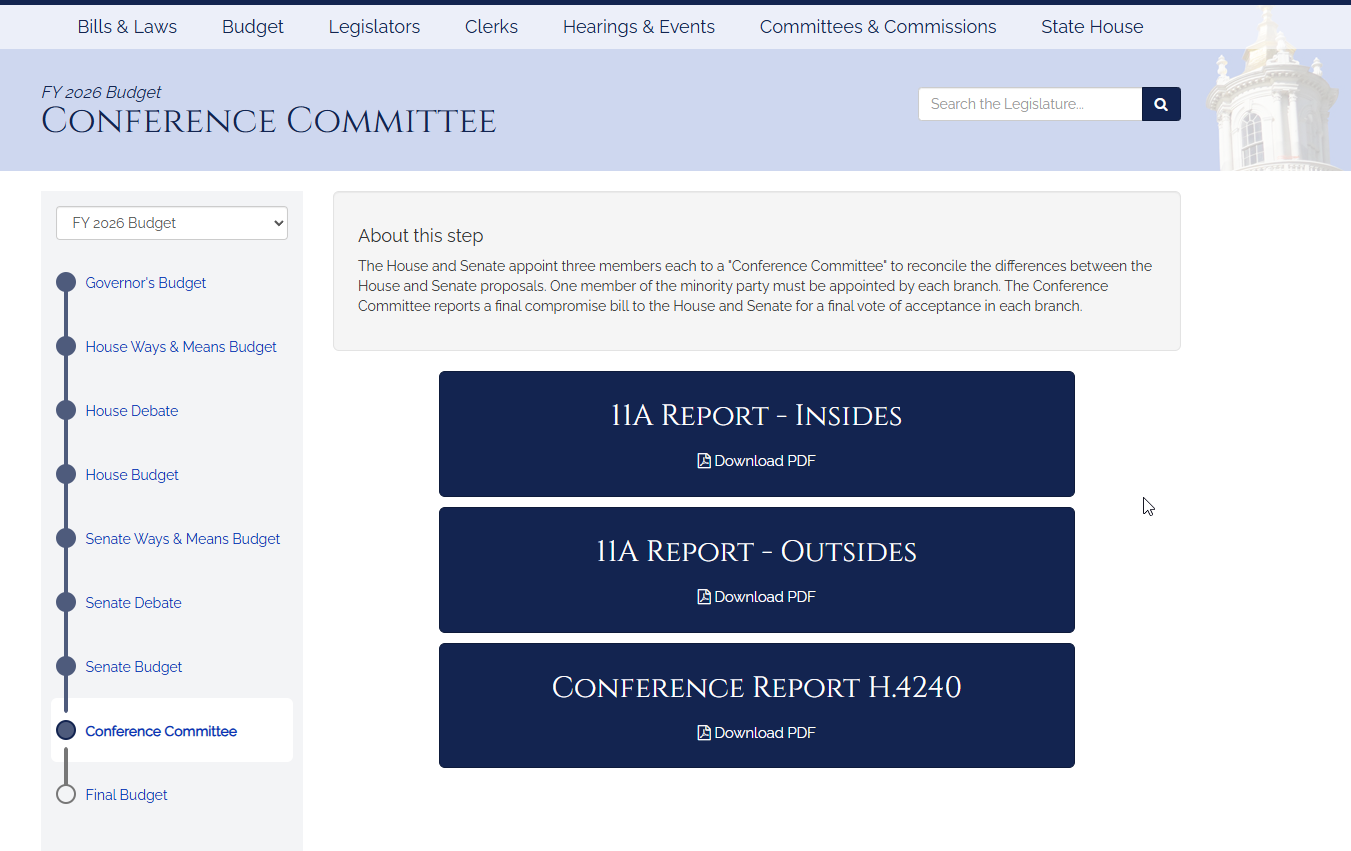
FY 2026 Budget Conference Committee. About this step. The House and Senate appoint three members each to a "Conference Committee" to reconcile the differences between the House and Senate proposals. One member of the minority party must be appointed by each branch. The Conference Committee reports a final compromise bill to the House and Senate for a final vote of acceptance in each branch. Conference Report H.4240 Download PDF.

A screenshot of the Fiscal Year 2026 budget still does not reflect accurate status as of July 8, 2025. The budget was signed July 4. (Image: Public Domain)

Unfortunately for renters, this law does not create better rental housing. It is housing affordability neutral.

What Does the Broker Fee Ban Say?

The Fiscal Year 2026 state budget contained a provision amending Section 87DDD1/2 of Chapter 112 of the General Laws. (The legislature might consider adopting revision management software, which would help eliminate shoehorned section numbers like “three Ds and a half.”) The law is wordy, but it’s short enough to reproduce the full text here:

A licensed broker or salesperson may solely contract with a prospective tenant to find rental residential real property for a tenant and present an offer to lease to the landlord or landlord’s agent and negotiate on behalf of the tenant or may solely contract with a landlord or landlord’s agent to find a tenant for a property. Any fee shall only be paid by the party, lessor or tenant who originally engaged and entered into a contract with the licensed broker or salesperson.

In plain English, a rental broker can contract with either the renter or the landlord. Whoever hires them first is responsible for the fee.

Key Points
  • The budget signed July 4, 2025, requires that whoever hires a rental broker pays their fee.
  • The cost of housing will not decrease. Landlords who are forced to pay their broker’s fee can raise the rent to pass costs through to the renter.
  • It was already illegal for landlords to charge renters a broker fee. The practice was widespread for lack of enforcement.
  • Zillow’s application fee is likely noncompliant.

What Problem Were We Trying To Solve?

Earlier this year, advocacy on TikTok and other social media channels promoted some municipal ordinances intending to regulate broker fees, especially in Boston. The TikTok posts shamed unnamed brokers who allegedly did nothing but unlock the door to an apartment and then got paid one month’s rent. The primary misinformation was that Boston was somehow the only market in the country with rental brokers. (To the best of our knowledge, no one has conducted a nationwide study of even the top markets, let alone all urban areas. Casual searches on Reddit for other major metro areas like Chicago indicate renter payment of brokers exists elsewhere.) The intent in all this was simply to eliminate broker fees paid by tenants.

Wasn’t It Already Illegal To Charge a Junk Broker Fee?

Yes. Under General Law Chapter 186 Section 15B, landlords may not charge anything other than first month’s rent, last month’s rent, a security deposit and the cost of changing the locks. Decades of case law have already established that landlords may not actually collect or even require anything with monetary value in excess of these four items. This means the following have been banned for decades:

  • Pet deposit.
  • Application fee, whether paid to Zillow or otherwise.
  • Renter’s insurance, whether paid to the landlord or an insurance broker.
  • Broker fee, whether paid to the landlord or a real estate broker.

Furthermore, real estate brokers have likewise already been regulated. Under 254 CMR 7.00, brokers may not charge a fee without a renter’s written consent. We wrote about this.

Even before the new budget language, it was unlawful for a landlord to contract with a broker and require the tenant to pay that fee. And it was unlawful for a broker to charge a renter without an agreement in writing in advance of showing the apartment.

If It Was Already Illegal, Why Was It Commonplace?

Boston, Cambridge, Somerville and a few other markets are extremely tight markets for renters. Many renters will therefore rationally forgo some rights under statute in order to get the apartment they want. Couple this with lax enforcement, and it’s easy to find landlords who are noncompliant. Some have said of their noncompliances, paraphrased, “I’ve been doing this for 40 years;” the reason is non-enforcement.

What Will Change Because of the Law?

The law contains no enforcement language. In political science terms, Massachusetts is a “weak enforcement” state. We cannot actually enforce much, so we rely on scaring people into voluntary compliance. But people weren’t following the law already. So here are four types of behaviors we expect to see, not all of which are compliant:

  1. Some landlords and their brokers will continue to require unlawful broker fee arrangements. Renters will continue to pay because of a combination of lack of education, lack of enforcement and desire to get an apartment.
  2. Some landlords will be scared into paying for the broker.
    1. Some percentage of these will raise the rent to recover this cost.
    2. Some percentage will not raise the rent directly because of the broker costs. This is the sliver of the population actually addressable by this law.
  3. Some landlords will prefer to consider an application from a renter represented by a broker, and renters will hire brokers at their own expense.

What Do Good Brokers Do?

A broker is licensed by the state; all brokers are required to be licensed and are regulated under General Law Chapter 112 Sections 87PP through 87DDD1/2, a combined total of 20 sections of law. No one can call themselves a broker without being licensed (Section 87RR).

When representing a landlord, a good broker will screen applicants. This can involve more or less work depending on the state of the apartment. An apartment in good shape may have many households inquire during peak season. Good brokers maintain accounts with listing services and background check companies. They do some of the landlord’s work to fill the unit. Surprisingly, a landlord-paid broker may also help renters by applying fair housing law and screening all applicants according to objective criteria.

When representing a renter, a good broker will help sift through hundreds or thousands of listings to find an apartment that meets their needs for which they can qualify. A good broker will also help a renter apply. For example, a Section 8 renter may not be able to explain the Section 8 program to their prospective landlords, but a good broker can. Or an international student may not know how to apply for an apartment here without U.S. credit, but a good broker can help the renter pull their international credit, document income or savings, or otherwise qualify. Surprisingly, a renter-paid broker may help landlords by preparing passing applications the first try.

Good brokers are inherently dual-sided. Good brokers make the market.

Broker agreements can be scoped to one or more units. A broker could sign with a renter to show a single unit, or could agree to show an unlimited number of units until the renter accepts an offer of tenancy, or anything in between. A broker could sign with a landlord to rent a single unit, or to manage all vacancies in a building for a period of time, or anything in between.

Prior to the passage of this law, a good broker would disclose dual representation: They could represent the renter for the application and then represent the landlord for tenant screening. This was commonly practiced especially in Section 8 and international student markets, where good brokers would charge half a month’s rent to each side of the lease-up for duties and obligations to each.

Can Brokers Still Maintain Relationships With Both Landlords and Renters?

Yes, nothing in the bill prohibits a broker from already knowing or having a professional relationship with both renters and landlords. If the relationship is formalized with a contract, then the person who signed the contract must pay for the broker. If both landlord and renter on a single transaction signed separate contracts, the first person to sign must now pay.

Non-contractual, informal relationships are not subject to the law. A broker could have a relationship with a network of housing providers, sign renters to pay all the fees, and then shop the renters around primarily to those in-network housing providers. Think about it this way: That’s what brokers do anyway. The law does not ban brokerage, nor does it stipulate that brokers must operate arm’s-length or contact only unknown landlords. It just clarifies who pays when a contract is in place. No contract? No change.

Can Landlords Require Renters Come With Their Own Broker?

No, this was not allowed under General Law Chapter 186 Section 15B even before this law passed.

Can Landlords State a Preference for Renters To Come With Their Own Broker?

Probably not. Consider for a moment a different example. A fixed-income retiree approaches you and asks to prepay the year’s lease. As the landlord, can you accept that offer? Chapter 186 Section 15B says we cannot require anything other than first, last, security or locks, and we cannot require any more than one month at a time. What if it’s the renter’s wish? Different judges have decided different things. Some limited case law has allowed prepayment if there wasn’t a hint of the landlord requiring it; other cases have come down so hard on prepayment that unrelated evictions have been dismissed for the apparent violation. All this makes prepayment a legal gray area.

Expressing a preference for a renter to bring their own broker likely falls into the same gray area.

Can Landlords Award More Points on an Application for Renters Working With a Broker?

Apparently so. A good broker paid for by the renter can still make the landlord’s job easier by preparing all information, running the background check and making sure the application has all required information the first time. If the broker knowingly submits false information, the broker’s license could be on the line.

The following checklist will tend to increase compliance for any landlord who wants to give more points for an applicant working through a broker:

  1. The landlord should work with any renter’s broker and should not be exclusive to any one broker.
  2. There should be no contract between the renter’s broker and the landlord.
  3. Applicants should NOT be advised to hire a broker at their expense. See above, “Can Landlords State a Preference for Renters to Come with their Own Broker?”
  4. The renter should sign a contract with their broker per 254 CMR 7.00.
  5. The landlord can award more points on an applicant qualifier for representation.

Talk with your attorney before modifying your applicant qualifier to award more points for representation; they will have to defend your decision.

To be clear, in all cases a broker paid by a renter should prepare the renter’s application or do other meaningful work for the renter. This was always the case even before the new law.

What About Zillow? How Are Zillow Application Fees Now Banned?

Zillow operates with a single real estate broker license in Massachusetts. This means it is subject to the new broker law. If Zillow ever engages a landlord first and subsequently charges a renter for their application, Zillow will not be in compliance.

Arguably, Zillow cannot be in compliance under its current business model. Zillow creates contractual obligations with both landlords and renters via its terms of use, which are required to use the service. It has to sign the landlord first before the renter can apply to an apartment. (If there were no listings, why would any renter enroll?) Under the law, Zillow as broker must therefore collect its fee from the landlord. Under present business practice, Zillow charges Massachusetts renters $35 for an “application fee” that gives renters 30 days’ access to apply to different landlords.

Whatever Zillow calls the fee is immaterial. Zillow must be a licensed broker to help renters apply. They are in fact a licensed broker. They have preexisting contractual relationships with landlords. The $35 is a fee paid to a broker and subject to the law. Arguably, Zillow can no longer charge a $35 application fee to Massachusetts renters.

It is unclear how Zillow could adapt its current model easily. Zillow may try to switch its model to charge the landlord $35 for a signed agreement. It is difficult to imagine enforcing this, when a landlord and renter who find one another on Zillow may lie to Zillow and say they didn’t end up signing a lease. In any event, presumably many more renters pay the fee than get apartments via Zillow, so Zillow’s revenue may decrease.

Zillow likely will have an army of attorneys and lobbyists to carve out an exemption for itself. Alternatively, there may be litigation by or against Zillow.

We have advised landlords since 2018 not to require or prefer the Zillow application. Landlords should use the MassLandlords rental application and treat screening as cost of doing business; free things to check should be checked first, before paid data sources. Landlords can list on Zillow without using the Zillow application. To learn tenant screening, take our crash course.

Can a Landlord Offer One Price for Represented Renters and Another for Others?

Probably not. Showing two prices where a renter-borne cost is involved is likely to run afoul of Chapter 186 Section 15B, which prohibits landlords from requiring up-front costs other than the four listed.

Can a Landlord Still Hire a Broker To Screen Tenants?

Yes, a landlord can still hire their own broker to do showings and review the prepared applications. The landlord will pay for the broker directly, and may raise asking rent to compensate.

Can a Brokerage Have Agents Representing Both Renters and Landlords on the Same Deal?

Apparently so. There is no case law yet, but the law seems to be about the person who holds the license rather than the organization for which they work. If there are multiple licensed brokers in an office acting independently on a deal, one licensee can represent renters and another can represent landlords. The fees can be different for each. The two brokers can collaborate on the same deal as long as the contractual obligations go with one license on either side.

There is nothing in the law restricting brokers or brokerages from having informal or contractual relationships with one another.

Can a Broker Charge Half a Month’s Rent, or Three Months’ Rent?

Apparently so. There is nothing in the law limiting what a broker charges. Brokers are subject to the anti-discrimination law, General Law Chapter 151B Section 4, but otherwise brokers can adapt, change their services, and charge as much or as little as their market will bear.

Can a Broker Charge Renters a Fee for No Apartment?

Yes. 254 CMR 7.00 is explicit in allowing for a broker to charge a fee even if no apartment is obtained. The fee must be agreed to in writing.

One unintended consequence could be overstated broker promises to find an apartment. “Hire me for a fee and I’ll submit your application to 100 apartments.” Such shotgun approaches might generate large amounts of money for renter-facing brokers and still comply with General Law Chapter 93A even if the renter never finds an apartment as a result.

What Would Happen if We Eliminated All Move-In Monies?

Eliminating move-in monies is a form of price control. As such, a phenomenon called “availability discrimination” would result. This means landlords would hold apartments vacant longer waiting for a renter who fits the desired risk profile. This has been theoretically modeled and experimentally confirmed, see for instance seminal work by Heikki Loikkanen, 1985.

For Renters: What Should a Renter Expect To Change?

Little will change. Under the new and existing law combined, a landlord can award more points for applicants that bring a broker. (It should not be a requirement.) The landlord should not say they are working with a particular broker and require you to pay for that one. You can hire your own broker at your own expense.

If you as a renter see a listing and contact the property owner, you may be directed to pay the landlord’s broker. This would be unlawful, but there is no additional money for enforcement in the state budget. If you attempt to sue the landlord, you will lose the apartment, and the case will take several years.

When inevitably you find a non-compliant landlord, you should do what it takes to get the apartment. Always speak with an attorney. Apartments are in short supply, and we don’t want you to do anything to hurt your chances. The fact that the legislature made a weak, unenforceable law is not your fault. You can attempt to enforce your rights once you have the apartment.

A landlord might suggest several brokers for you to evaluate and hire on your own. Alternatively, a landlord may say they are paying for the broker. A landlord who pays for a broker may increase the rent as a result.

Renters can look up a Certified Massachusetts Landlord™ to find whether there is additional enforcement available for any landlords operating noncompliantly.

What Would Be the Penalty for a Noncompliant Certified Massachusetts Landlord™?

Certified Massachusetts Landlord™ could have their certification revoked for non-compliance. This would remove them from the public lookup.

What Would Be the Penalty for a Noncompliant Landlord in General?

A renter would have to bring suit under General Law Chapter 93A for violation of Chapter 112 Section 87DDD1/2. This could get the renter three times whatever the broker fee was, plus attorney’s fees.

In actual practice, renters can be risk averse and may not litigate. See for instance the Ashley Security Deposit Story.

Why Doesn’t This Bill Fix Anything?

For starters, housing is very complex. There is insufficient technical expertise in the legislature to address housing as its own multidisciplinary problem. Pushing downs costs in one area cause them to spring up in another.

Second, as mentioned above, political science describes Massachusetts as a “weak enforcement” state. This means we rely on showy trials to scare people into voluntary compliance. In general, we don’t have the resources to require correct behavior in every instance.

Overall, some landlords used to require unlawful broker fees. Those landlords are unlikely to read the law now. The new law comes with no additional enforcement.

Section 8 Budget Cuts in 2025: Making Sense of the Headlines

Are Section 8 vouchers in danger this year? With Section 8 budget cuts in 2025 targeting housing programs, millions of renters wonder if their support will shrink—or disappear entirely. This guide breaks down the proposals, clarifies what’s changing, and offers practical advice on what to do next.

Why the 2025 Budget Matters for Low-Income Renters

The U.S. Department of Housing and Urban Development (HUD) faces significant funding cuts proposed for 2025. Such budget reductions can drastically impact programs crucial for affordable housing, especially the Section 8 Housing Choice Voucher program, which provides rent assistance to over 2 million households nationwide.

A smaller HUD budget means fewer vouchers, longer waiting lists, and potentially tighter eligibility rules. Understanding these changes early can help renters plan effectively.

What is the HUD Budget for 2025?

The proposed HUD budget for 2025 is approximately $70 billion, marking a reduction of nearly 10% compared to the previous year. Key programs facing cuts include:

  • Section 8 Housing Vouchers: Reduced funding could limit new enrollments.

  • Project-Based Rental Assistance: Likely to see reductions, impacting availability.

  • HOME Investment Partnerships Program: Potentially significant cuts that slow affordable housing construction.

These cuts, if enacted, will challenge efforts to reduce homelessness and improve affordable housing availability nationwide.

As of May 2025: These proposals are still under review. Final decisions on the budget are expected by early fall.

Can You Keep Section 8 Forever?

Technically, yes—if you continuously meet HUD’s eligibility criteria. Section 8 vouchers require annual recertification, verifying that your income remains below program limits and that you’re following program rules. Read the 2025 eligibility rules here to stay compliant.

However, budget cuts raise the stakes. Reduced funding could lead HUD to tighten eligibility or compliance requirements, increasing the risk of losing vouchers if household circumstances change slightly.

What is the Highest Income for Section 8 in 2025?

Income limits are set at 50% of Area Median Income (AMI), varying significantly based on your location. Here’s a generalized example:

Household Size Approximate Max Income (50% AMI)
1 Person $30,000–$40,000
2 People $34,000–$46,000
3 People $38,000–$52,000
4 People $42,000–$58,000
5 People $45,000–$62,000

Always confirm your local limits through your housing authority or check your state’s Section 8 guide to avoid surprises during recertification.

What’s the Downside to Section 8?

Despite being vital, Section 8 has downsides:

  • Limited Acceptance: Not all landlords accept Section 8 vouchers.

  • Stigma: Some landlords and neighbors unfairly stigmatize voucher holders.

  • Uncertainty: Budget fluctuations can affect availability and reliability of support.

Budget cuts amplify these challenges, potentially reducing landlord participation and increasing wait times.

How Budget Cuts Could Affect Section 8 Renters

The direct impact of 2025 budget cuts could include:

  • Fewer new vouchers issued, increasing wait times.

  • Potential for reduced payments to landlords, causing hesitancy to rent to voucher holders.

  • Increased likelihood of tighter income verifications and more frequent compliance checks.

What You Can Do to Prepare

Being proactive is crucial:

  • Join multiple waiting lists to improve your odds—check current openings here.

  • Regularly document income and household changes to streamline recertification.

  • Consult housing counselors or advocacy groups to navigate changes effectively.

FAQ

Will Section 8 still exist in 2025?

Yes, but funding cuts may reduce the number of new vouchers issued and extend waiting periods.

Can undocumented immigrants be affected by HUD cuts?

Undocumented immigrants already face limits. This guide explains how mixed-status families are affected. Budget cuts could further restrict mixed-status families, making it harder for eligible family members to access support.

Does the budget affect LIHTC properties too?

Indirectly, yes. Cuts in HUD funding may limit the resources available for developing new affordable housing through tax credits.

Final Thoughts: Stay Proactive Amid 2025 Budget Cuts

With budget cuts looming, now’s the time to act. Monitor announcements closely, explore multiple housing options, and leverage resources like AffordableHousingHub.org to secure your housing stability.

Source: https://affordablehousinghub.org/affordable-housing//section-8-budget-cuts-2025

What’s an Accessory Dwelling Unit? They may help the housing crisis in Massachusetts

Big problems don’t always need big solutions. In Massachusetts, one of the answers to the housing crisis might be hiding in the backyard. They’re called Accessory Dwelling Units, or ADUs for short.

Think of them as pint-sized homes, built on the same lot as an existing home. Once upon a time, these little homes were locked down by zoning rules, you could build one, but only if a relative was moving in. Renting to anyone else? Off limits. But now, building an ADU has become much easier.

For Linda and Mark Adler of Lexington, the solution to their own personal housing crunch didn’t just fall from the sky, but it did get slowly lowered from above.

Their new ADU was delivered in a couple of massive prefabricated pieces. A crane gently set them down in the side yard. Just like that, they had a brand new, two-bedroom, two-bathroom, 900 square foot home.

ADU crane
Part of an Accessory Dwelling Unit lifted into place with a crane. CBS Boston

“Two big pieces, on two flatbed trucks and an enormous crane lifting both pieces over our existing house,” said Mark. “Which was a little scary.”

The Adlers added the ADU when their daughter and grandkids moved in. Now, they’re living just steps apart, with much more room to breathe.

“For us it was an affordable solution to being close, but giving everybody space,” said Linda.

About 30 miles away in Northboro, Marsha Gleason built her own ADU in the backyard of the house she once shared with her late husband.

“My new home is just perfect for me,” she said. “It has allowed me to stay in my neighborhood.”

Accessory Dwelling Unit
Accessory Dwelling Unit in Northboro, Massachusetts. CBS Boston

Now, her son and daughter-in-law live in the main house. Marsha’s 800-square-foot home is filled with her artwork and she still hosts her friends and the occasional sleepover for her grandkids.

“I’ve had groups here,” she said. “I can still entertain.”

Accessory Dwelling Units in Massachusetts

Until recently, ADUs were nearly impossible to build in many Massachusetts towns, thanks to zoning restrictions and red tape. But that changed in August 2024 with the Affordable Homes Act.

What’s new? Well, there are no more special “ADU permits.” No more rules about ADU’s being for “relatives only.” Now, you can build an ADU that’s up to 900 square feet in size. It can be inside an existing home, attached, or completely separate, as long as it has its own entrance.  You can also rent out an ADU.

“We had a patchwork of regulations across Massachusetts, 351 cities and towns. Some you could build ADUs relatively easily, some you couldn’t build them at all,” said Ed Augustus, Secretary of Housing and Livable Communities. “Now, ADUs are one way we’re tackling the housing crisis.”

Augustus estimates 8,000 to 10,000 ADUs will be built in the next five years. But that’s just the start. The state says Massachusetts needs about 200,000 new housing units over the next decade to truly get ahead of the crisis. ADUs are just one piece of the solution.

Before you start sketching your backyard floor plan, there are a few caveats. Property taxes may go up.

Adding an ADU increases the value of your property, and likely your tax bill. Towns can still pass rules banning ADUs from being used as Airbnbs or other short-term stays. You’ll need to follow setback rules and other basics, even under the new law.

How much do ADUs cost?

Chris Lee runs Backyard ADUs, a company that builds these units off-site and installs them in a matter of months. The average price of one of his homes is around $300,000. They can run as much as $500,000. But the new laws are making ADU’s more popular.

“It’s getting easier,” Lee said. “Vermont was the first state in New England, Maine followed, Rhode Island followed, Mass. followed and now New Hampshire just followed. Basically New England is catching up with the West Coast.”

For some families, these small homes are delivering a big solution. For them, an ADU is A-OK.

For more information on the state’s new rules on ADUs visit Mass.gov.

Source: https://www.cbsnews.com/boston/news/accessory-dwelling-units-massachusetts/