Massachusetts homeowners facing crumbling foundations seek help paying for repairs

A group of central Massachusetts homeowners who have watched their foundations crack and crumble under their houses are now asking state officials for help.

“We have nowhere to turn,” said Michelle Loglisci, founder of Massachusetts Residents Against Crumbling Concrete.

The Massachusetts Residents Against Crumbling Concrete is an organization formed out of desperation.

WCVB’s Ben Simmoneau has reported on the struggle the residents have had after they learned the concrete in their foundations is contaminated by pyrrhotite – a naturally occurring mineral found in parts of the state that causes concrete to fail prematurely.

Homeowners have spent hundreds of thousands of dollars on repairs because they were not covered by insurance, and banks generally won’t lend money to cover the work.

“Does it take one to collapse? You don’t know, right? So we need to help the homeowners, and we need to help the communities,” said Karen Riani, of Holden.

Riani is among the 30 or so residents who will be meeting with lawmakers Monday to try to get them to support a house amendment that is expected to be filed to the Affordable Homes Act to set up a program similar to one already in place in Connecticut that helps homeowners pay for repairs.

“I’m more optimistic now, and I’d rather be positive than negative right now to make something happen,” Riani said.

This summer, Massachusetts will mandate quarries test their product for the presence of pyrrhotite.

Homeowners said that while that’s a good first step at preventing the problem from spreading, it’s not enough.

“Going to our Statehouse representatives and senators and ask them to help us just like Connecticut has. They have had a program operating now for over four years, and they have replaced over 900 foundations. We’re just asking for the same,” said Michelle Loglisci of Massachusetts Residents Against Crumbling Concrete

The homeowners are hopeful that the amendment will be filed in the next couple of weeks, and that debate can finally begin.


Source: https://www.wcvb.com/article/massachusetts-homeowners-facing-crumbling-foundations-seek-help-paying-for-repairs/60776386

19 Best Rental Listing Sites to Advertise Your Property in 2025

Choosing the best rental listing site can significantly streamline the process of finding your next tenant while reducing the time spent showing your rental properties. However, with so many property management platforms available, it can be challenging to identify which site is the right fit for your rental business.

To help you decide, we’ve reviewed 19 of the best rental listing sites to advertise your properties with an overview of their features, the platforms they syndicate to, and pricing.

1. Avail (Part of Realtor.com®)

Avail (Part of Realtor.com®) is a property management platform for independent landlords to advertise rental properties for free. With the option to list your rental across 20+ trusted rental listing sites, landlords can maximize their property’s visibility while also simplifying the management of tenant lead inquiries, applications, and leases.

Key Rental Listing Features

Avail provides comprehensive tools for advertising and setting a competitive rent price, such as the following:
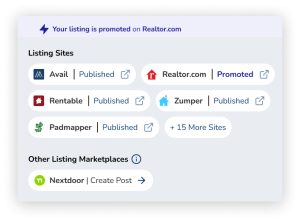
  • List your rental across 20+ rental sitesPublish your property across multiple platforms in minutes to maximize reach. With one click, you can get your listing across highly visited sites like Apartments.com and Realtor.com.
  • Promoted Listings tool: For increased exposure, get premium placement on Realtor.com, Rent., Rentals.com ApartmentGuide, Redfin, Zumper, and PadMapper with our Promoted Listings tool.
  • Customizable listings: Add photos, virtual tours, and your rental terms to build an engaging listing. You can also get auto-generated listing titles and descriptions based on your rental’s characteristics to save time building your listing.
  • Fraud protection: We have a dedicated team focused on preventing listing protection to provide a safe experience for landlords and tenants.
  • Property tour automation: Interested renters can book or request a tour directly from your Avail rental listings, reducing back and forth. Landlords can more than double their chances of receiving an application by including tour options on their listing
  • Direct application on Realtor.com: Renters can now apply directly from your Realtor.com listing, completing their applications 1.75x faster than standard leads.
  • Comprehensive rent analysis reporting: Set a competitive rent price for your listing with an Avail Rent Analysis report. Gain insights on local rental trends, rental demand, and comparable properties to determine the optimal rent price.

Syndication Platforms

Listings created with Avail appear on over 20 rental platforms, including:

  • Realtor.com®
  • Zumper
  • Rentberry
  • Apartments.com
  • Rentable
  • ApartmentList
  • Rent.
  • PadMapper
  • ForRent.com
  • Apartment Guide
  • Redfin
  • Rentals.com
  • ApartmentFinder
  • Movoto by OJO
  • ApartmentPicks
  • Apartmenthomeliving
  • Westside Rentals

Pricing

  • Unlimited (Free): Includes listing syndication across 20+ rental sites, rental property accounting, maintenance tracking, access to lawyer-reviewed lease agreements, and more.
  • Unlimited Plus ($9/unit per month): Includes all of the free listing features, plus waived ACH fees, FastPay, faster Customer Care support, and the ability to customize rental applications and leases.
  • Promoted Listings tool: Pricing varies on platforms and locations.

2. Zillow Rental Manager

Zillow Rental Manager enables landlords to advertise properties across Zillow, Trulia, and HotPads. With its strong reputation and market data tools, this platform helps landlords reach a large audience, streamline the property management process, and determine competitive rental rates.

Key Rental Listing Features

Zillow Rental Manager supports landlords with features such as:

  • Syndication to partner sites: Listings are automatically distributed to other Zillow-owned feeds like Trulia and HotPads.
  • Dynamic rent pricing insights: Use Zillow’s free market data to adjust your property’s rent price based on local trends.
  • Customizable listing building tool: Add photos, descriptions, 3D tours, and rental terms to create an engaging listing.
  • Direct applications feature: Interested renters can submit a rental application directly through a Zillow rental listing.
  • Visibility upgrades: Paid options allow landlords to enhance their listing’s placement and visibility.

Syndication Platforms

Zillow Rental Manager syndicates listings to:

  • Zillow
  • Trulia
  • HotPads

Pricing

  • Platform fees: Free
  • Paid listings: Pay $29.99 to get premium listing placement on Zillow’s networks for up to 90 days

3. Rent.com

Rent.com (owned by Redfin) offers landlords a simple platform for advertising rental properties while connecting them with renters. The platform syndicates listings to multiple affiliate sites, providing broad exposure and valuable rental pricing insights.

Key Rental Listing Features

Rent.com simplifies rental advertising with these tools:

  • Syndication to Rent.com partner sites: Reach more renters by having your listing automatically syndicate across partner sites, such as ApartmentGuide and Redfin.
  • Free rent price estimator: Access data to help set a competitive and fair rent price for your property.
  • Tenant review system: Build credibility by featuring feedback from previous tenants.
  • Lead management dashboard: Track and respond to tenant inquiries through your dashboard to keep everything in one place.
  • Premium visibility upgrades: Paid features like featured placement enhance your listing’s performance in crowded markets.

Syndication Platforms

Rent.com syndicates listings to its partner platforms, including:

  • ApartmentGuide
  • Rent.com
  • Redfin

Pricing

  • Free Listing: Basic advertisement for your rental property.
  • Paid Upgrades: Cost varies for premium placement and additional features.

4. Apartments.com Rental Manager

Apartments.com Rental Manager offers a reliable way for landlords to advertise rental properties across a vast network of rental platforms. Tools for managing tenant inquiries, screening, and rent pricing make this platform a popular choice among landlords.

Key Rental Listing Features

Apartments.com Rental Manager supports landlords with:

  • Syndication to multiple platforms: Listings appear on Apartments.com, ApartmentFinder, and more, maximizing exposure to renters.
  • Rent price comparison tools: Use rental market data to determine a competitive rent price based on local trends.
  • Customizable listings: Create property profiles with high-quality photos, detailed descriptions, and virtual tours.
  • Auto-generated titles and descriptions: Generate optimized titles and descriptions automatically, or customize them to highlight specific property details.
  • Tenant screening tools: Conduct credit and background checks to qualify renters.

Syndication Platforms

Listings created with Apartments.com Rental Manager appear on:

  • Homes.com
  • ForRent.com
  • ApartmentFinder.com
  • ApartmentHomeLiving
  • WestsideRentals
  • After55.com
  • Corporatehousing.com
  • Apartmentos
  • ForRentUniversity

Pricing

  • Free Plan: Includes basic listing and lead management features. If you have a single property with five or more rentals, you are required to purchase an advertising package to list it.
  • Paid Options: Enhanced listing services and visibility upgrades vary by location and property type.

5. Apartment List

Apartment List uses a match-based system to connect landlords with renters who meet their property criteria. Performance-based pricing ensures landlords only pay for successful leads, making it an efficient option for rental advertising.

Key Rental Listing Features

Apartment List simplifies rental advertising with:

  • Customizable listing profiles: Add detailed descriptions, professional photos, and rental terms to help you generate quality leads.
  • AI lead nurturing feature: Get access to Lea Pro, their AI leasing agent, which helps engage interested renters to qualified leads.
  • Rent pricing insights: Adjust rental rates using data from Apartment List’s network to align with market trends.
  • Match-based lead generation: Connect with renters whose preferences align with your property features.
  • Direct application options: Renters can inquire or apply directly through the platform’s dashboard for seamless communication.
  • Performance-based pricing: Costs are tied to the quality of leads or signed leases.

Syndication Platforms

Apartment List focuses on its own renter network and does not syndicate to other platforms.

Pricing

  • Performance-Based Pricing: Costs depend on the number of qualified leads or signed leases, ensuring landlords only pay for results.

6. Trulia

Trulia, owned by Zillow, offers landlords a comprehensive platform for advertising rental properties while highlighting neighborhood features. Listings created via Zillow Rental Manager automatically appear on Trulia, enhancing visibility.

Key Rental Listing Features

Trulia empowers landlords with tools designed to maximize tenant engagement, including:

  • Syndication with Zillow Rental Manager: Listings appear on Trulia, Zillow, and HotPads, ensuring broad exposure.
  • Neighborhood insights: Add detailed information about schools, amenities, and safety to attract renters seeking specific environments.
  • Dynamic rent pricing tools: Adjust rental rates based on local market data provided by Zillow.
  • Auto-generated titles and descriptions: Automatically generated titles and descriptions make it easy to create optimized listings quickly.
  • Direct application options: Renters can apply through the listing, with applications integrated into your Zillow Rental Manager dashboard.

Syndication Platforms

Listings posted via Zillow Rental Manager appear on:

  • Trulia
  • Zillow
  • HotPads

Pricing

  • Free in Most Markets: Basic listing and syndication tools are included.
  • Paid listings: Pay $29.99 to get premium listing placement on Zillow’s networks for up to 90 days

7. Innago

Innago is an ideal option for those who manage small to mid-sized portfolios. Known for its simplicity, Innago offers free tools for rental advertising, tenant screening, and rent collection to streamline the property management process.

Key Rental Listing Features

Innago provides landlords with essential tools for advertising and managing properties:

  • Customizable property listings: Create engaging advertisements with photos, descriptions, and rental details to attract qualified tenants.
  • Rental application integration: Allow renters to submit a rental application, credit check, background check, and eviction report directly from the rental listing.
  • Lead management system: Track inquiries and communicate with prospective tenants through Innago’s built-in tools.
  • Flexible rent pricing tools: Analyze property performance and market data to set competitive rental rates.

Syndication Platforms

Innago rental listings appear on:

  • Zillow
  • Realtor.com
  • Rental Source
  • Zumper
  • RentLingo
  • ULoop
  • PadMapper
  • Trovit
  • Movoto
  • Doorsteps

Pricing

  • Free: Innago offers its property management tools, including tenant screening, rent collection, and basic advertising features, at no cost.

8. Buildium

Buildium is a property management solution tailored for landlords managing larger rental portfolios. The platform offers robust tools for advertising properties, setting competitive rent prices, and handling tenant communications.

Key Rental Listing Features

Buildium streamlines property advertising and tenant management with features like:

  • Syndication to listing platforms: Publish properties to Zillow, Apartments.com, and Trulia, ensuring wide exposure.
  • Rent pricing insights: Analyze market data to help landlords set fair and competitive rental rates.
  • Customizable listing templates: Include detailed descriptions, photos, and property features to create professional listings.
  • Lead tracking and tenant applications: Manage renter inquiries and applications directly through the platform.

Syndication Platforms

Buildium syndicates rental listings to:

  • Apartments.com
  • Apartment List
  • Zillow Rental Network
  • Zumper
  • Craigslist

Pricing

  • Essentials Plan: Starting at $58/month, includes basic property management features like listings, rent collection, and accounting tools. Depending on the level of your plan, you may have to pay additional one-time charges for features like eSign.
  • Growth and Premium Plans: Scaled pricing for larger portfolios, offering advanced tools like automation and integrations.

9. Hemlane

Hemlane combines property management with rental advertising and local agent support, offering landlords a unique blend of control and professional assistance. The platform’s syndication capabilities and rent pricing tools ensure properties are advertised effectively to attract quality tenants.

Key Rental Listing Features

Hemlane provides landlords with tools to streamline the rental process, including:

  • Syndication to listing platforms: Publish rental properties to Zillow, Trulia, Apartments.com, and Realtor.com® with a single click.
  • Rent pricing tools: Access market data to determine competitive rental rates for your properties.
  • Customizable property listings: Build professional advertisements with photos, detailed descriptions, and rental terms.
  • Lead management system: Track renter inquiries and applications through the platform.
  • Local agent support: Gain access to local agents for showings and other tenant-related tasks.

Syndication Platforms

Hemlane syndicates rental listings to the following sites. However, the total amount of sites you can list will depend on your subscription plan:

  • Zillow
  • Trulia
  • Apartments.com
  • Realtor.com®
  • Regional platforms based on property location

Pricing

  • Free Plan: Allows you to list your rental across four main sites, screen tenants, and track income and expenses.
  • Basic Plan ($28 platform fee + $2/unit/month): Includes essential features like listings, screening, and rent collection.
  • Essential Plan ($28 platform fee + $20/unit/month): Adds automated late fees, maintenance management, and financial reporting.
  • Complete Plan ($28 platform fee + $68/unit/month): Includes local leasing agent support and premium features for hands-off property management.

10. Redfin

Redfin, primarily known as a real estate platform, also offers rental property advertising. With features focused on local market insights and rent pricing analysis, Redfin helps landlords attract tenants while leveraging its trusted reputation in the real estate market.

Key Rental Listing Features

Redfin assists landlords with tools for showcasing rental properties and optimizing listings:

  • Customizable property listings: Create professional advertisements with detailed descriptions, rental terms, and high-quality images.
  • Neighborhood insights: Highlight nearby schools, amenities, and transportation options to attract renters.
  • Rent pricing tools: Access market data to determine competitive rental rates based on local trends.
  • Lead management: Organize and respond to renter inquiries directly through Redfin’s platform.

Syndication Platforms

Redfin does not syndicate rental listings to external platforms. Listings are displayed exclusively on Redfin’s platform, targeting its established audience of property seekers.

Pricing

  • Free Listing: Includes basic advertising and lead management.
  • Additional Fees: Costs may apply for premium advertising or enhanced visibility options.

11. Rentec Direct

Rentec Direct is a platform designed to help manage mid-sized to large portfolios. The platform combines rental listing syndication with robust management tools to simplify operations.

Key Rental Listing Features

Rentec Direct offers tools to help landlords advertise properties and attract tenants:

  • Syndication to major platforms: Post rental properties to Trulia, Apartments.com, and other partner sites.
  • Customizable listing templates: Add photos, detailed descriptions, and rental terms to create engaging advertisements.
  • Rent pricing insights: Access reports and market data to help determine the best rental price for your property.
  • Lead tracking and tenant applications: Respond to inquiries and manage tenant applications directly through the platform.

Syndication Platforms

Listings created with Rentec Direct are syndicated to:

  • Dwellsy
  • Apartment List
  • Rental Beast
  • Trovit
  • Apartment Advisor
  • RentalSource
  • Apartments.com
  • Realtor.com®

Pricing

  • Pro Plan ($50+/month): Includes core features like listings, screening, and rent collection for small portfolios.
  • PMPlan ($50+/month): Adds advanced features for property managers and agents who manage properties for owner clients, such as tenant portals, and additional reporting tools.

12. Stessa

Stessa, known for its financial management tools, also offers a leasing feature that allows landlords to advertise rental properties and manage inquiries. This makes Stessa a dual-purpose platform for both property listing and financial tracking, ideal for landlords seeking a streamlined solution.

Key Rental Listing Features

Stessa combines leasing tools with financial insights to help landlords manage their properties efficiently:

  • Customizable property listings: Create detailed advertisements with high-quality photos, rental terms, and property descriptions.
  • Direct tenant applications: Prospective renters can apply directly through the platform, streamlining the application process.
  • Rent pricing insights: Use Stessa’s market analysis tools to set competitive rental prices based on local trends.
  • Tenant inquiry tracking: Manage and respond to prospective tenant inquiries from a centralized dashboard.
  • Financial integration: Automatically track rental income and expenses linked to your properties.

Syndication Platforms

Stessa syndicates listings to the following platforms:

  • Zillow Rental Manager
  • Trulia
  • Hotpads

Pricing

  • Free: Stessa’s leasing and financial management tools are available at no cost.

13. TenantCloud

TenantCloud is an all-in-one property management platform that helps landlords advertise rental properties, screen tenants, and manage day-to-day operations. Its syndication capabilities and customizable listings make it a great choice for independent landlords.

Key Rental Listing Features

TenantCloud offers a range of tools to simplify rental advertising and management:

  • Syndication to listing platforms: Post rental listings on Zillow, Trulia, Apartments.com, and other partner sites.
  • Customizable property profiles: Create engaging advertisements with photos, descriptions, and rental terms.
  • Rent pricing tools: Use data insights to set fair and competitive rental rates based on local trends.
  • Premium placement tool: Landlords can pay an extra fee to get premium placements on Rent.com, Apartment Guide, Redfin, RealtyStore.com, and more.
  • Tenant applications and screening: Accept applications directly through the platform and perform background checks.
  • Lead tracking and communication: Manage tenant inquiries and applications seamlessly.

Syndication Platforms

TenantCloud syndicates rental listings to:

  • Rent.com
  • Zillow
  • Trulia
  • Apartments.com
  • Realtor.com®
  • PadMapper
  • Other regional platforms

Pricing

  • StarterPlan ($17/month) includes rent payments, maintenance management, listings and applications
  • Growth Plan ($32/month): Everything in Starter plus lease builder and forms
  • Pro Plan ($55/month): Everything in Growth, plus advanced features like tax reports, application customization, and reconciliation
  • Business (not disclosed): Everything in Pro plus team tools, task management, and listings auto-refresh

14. TurboTenant

TurboTenant focuses on helping landlords advertise rental properties and screen tenants. Its free syndication capabilities and tenant application tools make it a popular choice for independent landlords.

Key Rental Listing Features

TurboTenant provides landlords with tools to create and manage rental listings efficiently:

  • Syndication to listing platforms: Publish rental listings on Apartments.com, Realtor.com®, and more.
  • Customizable listing templates: Add professional descriptions, photos, and rental details to attract quality tenants.
  • Rent pricing reports: Access local market data to ensure your rental price is competitive.
  • Tenant applications and screening: Receive applications directly through the platform and perform credit and background checks.
  • Communication tools: Track and respond to tenant inquiries through an integrated messaging system.

Syndication Platforms

TurboTenant syndicates listings to the following. Other sites may be options, but this depends on the amount of units you have and the property type.

  • Apartments.com
  • Realtor.com®
  • PadMapper
  • Rent.com
  • Zumper.com
  • After55.com
  • Apartmentfinder.com
  • ApartmentHomeLiving.com
  • Apartmentos
  • CorporateHousing.com
  • ForRent.com
  • Dwellsy
  • Other regional platforms

Pricing

  • Free Plan: Includes rental listings and applications, but offers limited functionality
  • Screening Fees: Reports start at $35, covered by tenants
  • Pro Plan: Must purchase an annual subscription, at $149/ year

15. Zumper

Zumper is a rental platform designed to connect landlords with prospective tenants quickly and efficiently. With built-in tools for syndication, rent pricing, and tenant applications, Zumper makes it easy to market your rental property to a large audience.

Key Rental Listing Features

Zumper offers landlords several tools to optimize their rental property advertising:

  • Syndication to multiple platforms: Publish your listing on Zumper’s network and partner sites, such as PadMapper.
  • Customizable listings: Create detailed advertisements with professional photos, rental terms, and property features.
  • Dynamic rent pricing tools: Use Zumper’s market data to determine competitive rent prices based on your location.
  • Tenant applications and screening: Renters can apply directly through the platform, with options for credit and background checks.

Syndication Platforms

Listings on Zumper are syndicated to:

  • Zumper
  • PadMapper
  • Additional regional platforms, depending on availability.

Pricing

  • Free Plan: Includes basic listing and syndication tools.
  • Premium Listings ($29.99/month): Increases your listing’s visibility and provides enhanced marketing options.

16. Facebook Marketplace

Facebook Marketplace is a social media platform that allows landlords to advertise rental properties to their local community. With its broad user base and easy-to-use interface, it is one of the most accessible ways to connect with renters.

Key Rental Listing Features

Facebook Marketplace simplifies property advertising with these features:

  • Localized listings: Advertise properties to renters searching within specific geographic areas.
  • Cost-effective advertising: Listings are free, making it an excellent option for landlords on a budget.
  • Integrated messaging: Communicate directly with prospective tenants through Facebook Messenger.
  • Photos and descriptions: Add detailed property descriptions, rental terms, and photos to create an engaging listing.

Syndication Platforms

Facebook Marketplace does not syndicate to other platforms. Listings appear only on Facebook, targeting local renters.

Pricing

  • Free: Includes property listings and messaging tools.

17. RentRedi

RentRedi delivers an intuitive solution for landlords, streamlining the process of advertising rental properties, screening tenants, and managing day-to-day property tasks. Tailored for independent landlords, RentRedi makes it simple to showcase your rentals and connect with qualified tenants efficiently.

Key Rental Listing Features

RentRedi supports landlords with tools to advertise and manage their rental properties:

  • Syndication to listing platforms: Listings are seamlessly syndicated to trusted platforms like Realtor.com®, Apartments.com, Zumper, and PadMapper, expanding visibility to a wide audience.
  • Customizable listings: Add photos, property descriptions, and rental terms to create compelling advertisements.
  • Tenant applications and screening: Prospective renters can apply directly through RentRedi, with screening tools to check credit, criminal, and eviction histories.
  • Rent pricing tools: Use rental data to determine a fair and competitive rental price for your property.
  • Lead tracking and management: Respond to tenant inquiries directly within the platform.
  • Performance tracking: Use built-in analytics to monitor the engagement and effectiveness of your rental listings, enabling continuous optimization.

Syndication Platforms

RentRedi syndicates listings to:

  • Realtor.com®
  • Apartments.com
  • Zillow (with extra steps)
  • And other regional platforms, depending on location.

Pricing

  • Starting at $19.95/per month: Includes rental listing syndication, tenant applications, and management tools.
  • Monthly Plan ($29/95/per month): Discounts can be applied annually or in six-month installments.
  • Annual Plan ($199.95/year): Offers savings for landlords who choose an annual subscription.

18. DoorLoop

DoorLoop is a full-suite property management software designed for landlords and property managers. While its focus is on streamlining property operations, DoorLoop also offers tools for advertising rental properties and setting competitive rent prices.

Key Rental Listing Features

DoorLoop provides landlords with a variety of tools to market and manage their rentals effectively:

  • Syndication to major platforms: List properties on Zillow, Trulia, Apartments.com, and more.
  • Customizable advertisements: Create professional listings with detailed property descriptions, photos, and rental terms.
  • Rent pricing analysis: Use DoorLoop’s market insights to set optimal rental rates.
  • Tenant applications and screening: Renters can apply directly through the platform, with options for credit, eviction, and criminal background checks.
  • Lead management tools: Track tenant inquiries and manage communications from a central dashboard.

Syndication Platforms

DoorLoop syndicates listings to the following sites with the Zapier plug-in:

  • Zillow
  • HotPads
  • Trulia

Pricing

  • Starting at $69/per month: Includes listing syndication, tenant applications, and management tools. However, it’s important to note their pricing scales with the number of units with the first increase at 20 units.
  • Custom Plans: Available for landlords with larger portfolios or specific needs.

19. HotPads

HotPads, a subsidiary of Zillow, specializes in rental property listings with a focus on urban areas and mobile-friendly experiences. The platform is part of Zillow’s network, which ensures wide exposure for landlords seeking to advertise their properties.

Key Rental Listing Features

HotPads offers landlords a variety of tools to enhance their rental property advertising:

  • Syndication through Zillow Rental Manager: Listings created on Zillow Rental Manager are automatically displayed on HotPads and Trulia.
  • Customizable listings: Add detailed property descriptions, photos, and rental terms to attract prospective tenants.
  • Mobile-friendly platform: HotPads focuses on providing a seamless mobile experience, making it ideal for renters searching on the go.
  • Rent pricing tools: Use Zillow’s market data to analyze local trends and determine competitive rental rates.
  • Tenant applications and screening: Accept applications directly through the listing and access credit, eviction, and background reports.

Syndication Platforms

HotPads syndicates listings through Zillow Rental Manager, which ensures visibility on:

  • HotPads
  • Zillow
  • Trulia

Pricing

  • Free in Most Markets: Basic listing tools are included at no cost
  • Paid listings: Pay $29.99 to get premium listing placement on Zillow’s networks for up to 90 days

What To Look For in a Rental Listing Platform

A great rental listing platform should help you get your rental in front of prospective renters and generate quality leads. When choosing the right property for your marketing needs, consider looking for the following:

  • Rental listing visibility: While there are highly visited sites like Zillow, 82% of renters use at least three or more internet listing services (ILSs) during their property search. With that in mind, look for a platform that lists your apartment, condo, townhome, or single-family home across multiple feeds to increase your visibility.
  • Fraud prevention: Rental scams are becoming more common, causing renters to turn to trusted rental sites with fraud prevention programs. So use a platform that can post your listing across secure rental feeds and add visual markers that your listing is trusted to increase clicks.
  • Writing support: Your rental listing title and description can influence overall engagement, so you’ll want to include the details that make your unit stand out. However, if writing isn’t your favorite task, consider using a platform like Avail that offers suggested titles and descriptions based on the provided information.
  • Tenant screening tools: After a prospective renter has shown interest in your unit and viewed it in person, the immediate next step is requesting a rental application and locally allowed screening reports. Look for a rental listing platform that allows you to screen tenants, accept or deny applications, and onboard them for rent collection.

Maximize Your Reach With Avail

Finding the perfect tenant starts with getting your listing in front of as many qualified renters as possible. To make that process seamless, you need a platform that not only boosts your property’s visibility but also simplifies how you manage leads, applications, and tours.

With Avail, you can syndicate your listing to 20+ leading rental sites, including Realtor.com®, in just minutes. Renters can easily schedule tours directly through your listing and apply on Realtor.com®, making it faster and easier to connect with serious prospects.Our landlord tools also streamline the rental process by helping you manage inquiries, screen applicants, and collect rental applications all in one place.

Create an account today to save time, reduce hassle, and find your ideal tenant with landlord software built with your needs in mind.

Source: https://www.avail.co/education/articles/15-best-sites-for-advertising-your-rental-property-listing

Eviction Sealing Effective May 2025 – What Landlords Need to Know

Gov. Maura Healey signed 193 H.4977, also known as the Housing Bond Bill, into law on Aug. 1, 2024. The bill included eviction sealing, effective in May 2025. Here’s what you need to know.


Eviction sealing appeared in the House’s version of the Housing Bond Bill as H.4356, and was passed into law with very few changes made during conference committee. It appears as Section 52 of Chapter 150 of the Acts of 2024 and has its permanent location in Chapter 239.

As we did when H.4356 was introduced, we have prepared a line-by-line explainer of this law. The eviction sealing law stands to harm housing providers and good renters, and will place excessive burden on the courts. This article provides an overview of the law’s talking points.

In almost all cases, renters seeking to have their eviction sealed must notify the landlord, who has seven days to object to the process, at which point a hearing would be held. How the landlord must be notified is unclear.

Think a credit report will show owed judgments? Probably not anymore, as credit reporting agencies will have to monitor for sealed evictions constantly. (Image: Licensed 123rf)

No Cause Stated Evictions Sealed Immediately

No-cause-stated evictions, also called no-fault evictions by renter advocates, are typically conducted when the landlord needs to deliver the property vacant for a sale, needs to use the unit themselves, or if the landlord is not able to provide enough evidence to make a for-cause eviction stick.

Under eviction sealing, a tenant can request this record be sealed as soon as the eviction process (including any appeals) is concluded.

This sounds fine until you realize that there are cases in which a no-fault eviction is the only way to get problematic tenants out, particularly if other tenants do not testify. We use Gwendolyn Property Management v. Goodwin as a prime example. The landlord had witnesses to the fact that the tenants were smoking in and around a non-smoking unit, but the judge threw it out as hearsay. A second eviction not for cause was the only way to remove the tenants. Is this a tenant you’d want renting from you?

Nonpayment Eviction Sealed in 4 Years

If a renter is evicted for nonpayment, they too may request that record be sealed. They just have to wait for four years from the conclusion of the case and appeal (if any). As long as they have not been filed against for nonpayment in that time, and they state that the reason for nonpayment was due to economic hardship, their record may be sealed.

The tenant must prove that hardship to the courts, though the law is murky about what constitutes “hardship.” Electric rates have risen sharply this year; will a higher utility bill count if the tenant says they paid Eversource and shorted the landlord to do so?

The landlord may object, and if they do, a hearing will be held. In other words, the court is going to have to listen to the eviction saga all over again before sealing the record (or not).

For-cause Evictions Sealed After 7 Years

A renter who is evicted for cause may petition to have their eviction record sealed as long as they avoid another no-cause-stated eviction case for seven years from the date of their case’s conclusion, and any appeals if applicable.

However, the law does not specifically state that other types of evictions count against the renter’s timeline. For example, if Ronald Renter has a for-cause eviction in 2025, and gets a nonpayment eviction filed against him in 2027, this does not interrupt the seven-year clock for sealing his for-cause eviction. And in fact, none of the timelines for any type of eviction specify that other types of eviction will interrupt the timeline toward getting the first case sealed.

If a renter is evicted for violating the “common nuisance law” (Chapter 139), they too may petition to have the eviction sealed after seven years. The courts will need to determine if they have had any violations in that timeframe. The common nuisance law includes charges such as prostitution, lewdness, gambling, alcohol served to minors, bootlegging, threat of violence, drugs, firearms and other illegal weapons, and explosives.

Cases Where Renter Prevails Immediately Sealed

In any eviction case where the renter wins, they may petition the court to have that record sealed as soon as the case/appeal is concluded.

To do so, the renter must return to the court where the case was held, but in this instance, the landlord does not need to be notified, presumably because the renter won the case.

Landlords: Tell Court When Judgment Has Been Satisfied…Or Else

A judgment for nonpayment is good for 20 years in Massachusetts. If a tenant pays off that money owed, it should be recorded as a satisfaction of judgment with the courts. Not every satisfied judgment was recorded, though; this was a problem eviction sealing advocates were trying to solve.

The eviction sealing law now requires landlords to inform the courts when a judgment has been satisfied, and requires them to do the same for agreements. Again, the wording is unclear. Sometimes agreements are satisfied on a continuing basis, such as a ruling that all rent must be paid by the 5th of the month. Does the landlord need to notify the court monthly?

Regardless, if the landlord does not notify the court that the judgment or agreement has been satisfied, the renter has the option to petition the court to declare the judgment or agreement satisfied.

The landlord must be notified if the renter petitions the court. If the landlord objects, then the court must hold a hearing and determine whether the judgment was actually satisfied.

But if there is no objection from the landlord, the courts must mark the judgment as satisfied. If the renter is prepared to lie in court, the landlord is left to prove a negative (“they did not pay me the owed money”). Proving a negative is very difficult. If the renter is prepared to commit perjury, this is a workaround to the 20-year judgment timeline.

Evictions with satisfied judgments can be immediately sealed if the renter petitions.

Who Can See Sealed Eviction Records?

The law does allow for some instances where sealed records may be accessed. Law enforcement can access them for the purposes of criminal investigation or criminal trials where the sealed eviction is relevant and/or part of evidence.

Journalists, researchers and law enforcement must petition for access to sealed court records. The court has this discretion as long as the request is for “public safety, scholarly, educational, journalistic or governmental purposes only.”

This means it’s up to the court to determine whether the requesting party is asking for the right reasons. Records may never be used for “commercial purposes.” Will the courts consider a media outlet commercial, if the outlet sells ad time or copies of its publication? Another gray area.

If you are a party to the case (landlord or tenant), you may petition to access your own record. Either you or your legal representation can request this.

Credit reporting agencies may not report on information contained in sealed records. Since evictions may be sealed at many different points following the conclusion of a case, such agencies would need to continually scour court reports to see what evictions have been sealed and remove them. This likely means credit reporting agencies will stop reporting for-cause evictions after 7 years, nonpayment after 4 years, or no-cause-stated evictions at all, regardless of whether they have been sealed.

Credit reporting agencies may still report publicly available information.

The Fallout of Eviction Sealing

At time of writing, eviction sealing does not take effect until May 2025, but we can predict some of the negative outcomes.

First, as landlords lose money on unpaid rent and property damage that they could have otherwise foreseen, rents will increase. We see this when rental units are renovated or retrofitted, and the same will apply here.

The 96% of renters who previously relied on a clean eviction history to bolster their application may find it harder to get approved for rentals. Conversely, the 4% of bad renters, such as professional tenants like the Callahans, will be protected as long as they manage to go four years without an eviction for nonpayment. All they need to do to make that happen is move over the state line and cause havoc elsewhere for a little while.

The new requirements on the court, including researching criminal histories and essentially re-conducting eviction hearings, will bog down an already over-burdened system. This is the last thing anyone needs.

We will continue to update this article as eviction sealing progresses.

Source: https://masslandlords.net/laws/eviction-sealing/

Virtual Showings: Show and Tell for Rental Properties

Show and Tell for Rental Properties
You have heard it said many times: A picture is worth a thousand words. If this is true, a well-staged, bright environment featuring a video tour of the property set to pleasing background music, has to be a worth volumes.

Virtual Showings
Today, everyone is afraid to make physical contact, never mind letting strangers into their homes. So how do you get over the hurdle of having to show a rental? You can follow all of the social distancing protocols previously mentioned, but there may be a better way.

We all know postings with pictures get noticed, but the pictures have to be great or they can produce a negative result. There are three levels of virtual tours we have found to be effective at varying price points.

Pictures
This solution can range anywhere from photos from your phone to having a professional stager and photographer shoot the environment to show it at its best. It all depends on your entry price point and what you think you can rent the unit for. It is easy enough to upload pictures from your phone to your website or any number of apartment rental websites. The better your pictures are, the better your chances of having some great pictures to work with for your marketing flyers and advertising.

Videos
If you have about fifty or more photos of the rental, you can take it to the next level and string these together as a video slideshow. There’s free software just a few clicks away on a Google search to do this. On the Mac, there are programs like “Photos” or “iMovie” that are a great way to get some enticing videos of your space. There is also a feature to add soundtracks to your movie to help set the mood. These videos can then be easily uploaded to your website or a “YouTube” channel for your rental business.

Another option is to purchase a hand-held video stabilizer for about $100. You can attach your phone or digital camera in the stabilizer to shoot a walk-through video of the rental space. We suggest a stabilizer because our first attempts with this method resulted in jittery videos. Eliminating the bounce from your reel would be ideal. With iMovie, you can remove the apartment sounds, and once again enhance the experience with a suitable soundtrack. Then upload these just as you would any other videos or pictures to ad sites or “YouTube.”

Top 10 mistakes beginners make when filming video with their iPhone
https://www.youtube.com/watch?v=2JM51Ocmitw

  1. You have to remember that your phone is a phone.
    Go into do not disturb, or airport mode.
  2. Running out of battery and memory storage.
    You can get an external drive to download.
  3. Do not forget to lock your exposure in your native application. A square box shows up and you can tap on what you are focused on to do this. Lock the exposure by tapping and holding what you are focused on.
  4. Having crappy audio. Audio is a big deal.
    You can use external mics on the iPhone.
  5. Having crappy lighting. You do not have to go out and buy all kinds of expensive equipment, just make sure you have good lighting. Daylight works great.
  6. Zooming. Do not use the zoom. It creates grainy pictures in your videos.
  7. Filming in a high dynamic range situation. Really bright lights, and really dark shadows. Part of your video will be under exposed or overexposed. Change the view around to have proper exposure.
  8. Only using the native app. iPhone app is super easy to use. Take advantage of the time-lapse and slow-motion right on your iPhone.
  9. Expecting to be amazing at capturing video the first time around. It is going to take some trial and error. Do not give up!
  10. The video has no point to it. Make sure you have a message with your video. As simple as a video montage of the features of the apartment.

3D Virtual Tours
The next tier up in scale is to make an investment in a 360-degree camera and some software to create virtual 3D tours of your rental. A good 360-degree camera starts at about $1,000. Then the monthly software to host your tours depends on your volume of rentals.

At this level, you need to make a business decision. Realtors use these cameras in marketing properties because they can justify the cost from the commissions from the sale. But does it make sense for the landlord? Do you have the number of rentals you need to support the expense? Or, in a COVID 19 world, is this a sign of what is to come?

3D Virtual Tours PROS

  • Safe to view from home in a COVID 19 World, 24/7, 365 days, around the clock
  • With a virtual tour you set it up once and re-use for multiple tours
  • No more “no shows” or wasting your time to show vacancies
  • A candidate can take their time, then share the link with significant others
  • 3D tours allow you to spin your head around to see EVERYTHING
  • It sends a message about the caliber of your business – very professional

3D Virtual Tours CONS

  • There is a learning curve to do something different and new
  • There is an expense to start using this technology
  • There is likely to be a monthly subscription service fee
  • The rent amount you are asking for may not justify the cost for this feature
  • The condition of the rental unit may work against you, no place to hide defects
  • Even after the 3D tour, candidates may still want to see it (verify them first)

Top 3 Reasons to consider Virtual Tours

  1. Virtual Tours will keep you, your family, and everyone’s family safe
  2. Virtual Tours can automate the way you market your rental process
  3. Virtual Tours allow candidates to view on their own time, thus saving yours

If the unit is occupied and you think Virtual Tours will work for you, give your resident a call and do the following:

  1. Explain your concerns for their health, your health, and letting strangers into the rental unit
  2. Explain that by only having one person enter to shoot the video, you can give unlimited tours moving forward without having to displace or put your resident at risk
  3. Offer your resident a convenient time and date to come in to shoot a virtual tour on your mobile phone (5 to 15 minutes)
  4. Thank your resident with a gift card for $20 to $30 dollars
  5. Open up a YouTube account to upload the video(s)
  6. Post the video with contact information and links to your online Rental Application
  7. Serious candidates will download, fill out, and send back the Rental Application plus required documents to verify income, landlords, and rental history
  8. Start the screening and selection process to find the best candidate
  9. With an online service like ZelleVenmo, or PayPal, accept a holding deposit from a qualified candidate
  10. Sign the lease (online), set up a lock box for access, and start collecting rent (online)

3 Examples of online tours

Still Image Slideshow
Created with Mac “Photos” app

iPhone Video Walk Through
Created with Mac “iMovie” app

360 Virtual Self-Guided Tour
Created with Matterport Subscription Service and 360 cameras

Online Rental Applications
Even before COVID 19 happened, we realized we were spending a small fortune printing out our rental applications every month. Our rental application is currently 16 pages long, and it took time and resources every month to keep a healthy supply in stock. Then, there was always the issue of how to drop it off and then pick it up again. At showings, we always had candidates ask if they could take it with them, and then we never saw them again.

In 2019, we took our Belaire Rental Application and created a secured PDF document we are able to email to ALL candidates at their request. We created the application with editable field forms so anyone could download the PDF, open it with a password, fill in the blanks, and send it back as a secure online document. This practice alone has saved us hundreds of dollars a month.

We also use professional property management software. Each time we post a listing, our software creates an individual rental application based on a template we create to meet our criteria. We can then track traffic for individual units and screen the online applications as they come in, safe and secure.

Online Rental Application Methods

  1. Email
    In its most primitive use, it is feasible to send a list of questions back and forth to capture the basic rental application requirements with pictures of documents as attachments. Not a very secure practice at all.
  2. Websites
    For a modest price you could have a web site put together with an online form as your rental application. Important documents will still need to be sent via email or text. A more secure practice.
  3. PDF Forms
    It is easy to convert any document into a PDF to use as your rental application with editable form text fields. Still need to be sent via email or text. PDFs can be password protected.
  4. Word Docs
    Not everyone has Word, but this could be an option similar to sending a PDF. Documents and critical attachments till need to be sent via email or text. PDF documents can be password protected.
  5. Property Management Software
    When you get to 10 or more units, it may make sense to use online professional property management software. Track leads with ease, post rental ads & video, text and email capabilities, all within an online secure database.
  6. Online Verification of Residents
    Not much has changed here for screening during COVID 19. We have always performed a full pre-screening regime on all applications we receive. With a phone number, emails, texts, and a computer, we can complete most of these tasks without physical candidate contact.Top Ten Steps to qualify for our rentals are:

    1. Completed Rental Application for all applicants 18 years old and over
    2. Valid Photo ID for all applicants 18 years old and over
    3. Verification of Income from each applicant for the past 2 months
    4. A combined Rent/Income Ratio of at least 3.75
    5. No outstanding balances owed to other landlords (http://www.masscourts.org)
    6. Not currently in the process of being evicted (http://www.masscourts.org)
    7. No Felonies which may endanger our rental community
    8. No Smokers (cigarettes or anything else)
    9. If the candidate is weak but otherwise qualifies, a co-signer living in our state
    10. After passing these, a positive Credit Report looking for delinquent payments

If the candidate passed our initial background check (steps 1 thru 9), we will ask for at least one-month rent as a holding deposit while we complete our due diligence. After we receive the deposit, we pull a credit report to verify no other red flags appear on the applicant or the other occupants. If all systems check positive, we will move forward and offer the rental unit to the candidate.

  • Leases, Lock Boxes, and Move-In Inspections
    We have reached the final stage of our virtual rental process journey. We have completed our due diligence and found a qualified candidate that meets our rental criteria. The next steps are the final checklists to set up the occupancy, sign the required documents, and deliver the rental unit to our new resident.

    • Leases
      Our one-year lease is an online dynamic document that we set up for our residents in our property management software. Once it is completed with the specific details from our leasing questionnaire, we create a custom lease from our template specific to the unit going under agreement. Once the custom lease is created, we send out the link to the lease document via email for all residents and co-signers to read and initial and sign on all required pages. After all renters and co-signers have completed the lease signing, we are notified the lease is ready for us to countersign.The Lease Questionnaire Covers the Following Details:

      • Resident Information
      • Renter’s Insurance Requirements
      • Security Deposit Portion Amount(s)
      • Military Affidavit
      • Possession of Firearms LTC
      • Emergency Contact ICE
    • Deposits
      The initial holding deposit will be transferred to the resident accounting and recorded as a first month rent only. The next deposit is for the last month rent, which goes to the landlord to be placed in escrow. The final monies received are designated to be deposited into an escrow account for the Security Deposit. We always do the Security Deposit as the last step only after all inspections and other deposits have been received.
    • Utilities
      Just before the last step we need to verify the new resident has successfully been able to activate the utilities in their name on or before the move in date. If a resident cannot, or will not activate the utilities, all bets are off and we will refund all deposits. We will not give out the keys without completing this step.
    • Lock Box and Keys
      Success! We have reached the finish line! All other systems have checked out with a positive outcome. We have completed the rental application process, received all of the deposits which have cleared our operations bank account, transferred the utilities, and signed all of the required paperwork online with little or no contact with the candidate.The last step is to put a lock box on the building with the desired number of keys for the new resident, send them the access code, and welcome them home to the Belaire Property Management Rental Community.

What’s on Your Mind?

Do you have any other ideas on this topic you could share to help our online community? Please chime in to share a comment or review. All feedback is welcomed. Thank you in advance for your continued support!

Warmest regards,

Brian Lucier
NWCLA.com

Big profits from smaller deals

A path to building wealth through small apartment buildings.

Choose your path

The subtitle for this article is “A path to building wealth to real estate.” We called it “a path” because there are many roads that can lead to building wealth through real estate. There are mobile home parks, syndications, condominium conversions, single-family homes, commercial space, industrial space, strip malls, offices, malls, you get the idea that the list could go on and on and on. Everything around us and everything we touch and see is somehow related to real estate investing.

The version I’m going to cover in this article focuses on buying smaller rental apartment buildings. Right now, in the rental market where we run our property management business, there is a gold rush of investors both seasoned and new who are racing along full throttle to get their hands on a deal. We hear some people say “there are no deals to be found out there anymore.” The truth is, you need to create your own deal. Sure, it’s true that for every listing that goes on the market these days, the offers flood in at $20k, $30k, even $50,000 over asking price. We have seen insane terms for call cash offers and waving all types of inspection contingencies. Don’t get me wrong. The strategy could work during the right time of the market if you know your numbers and have a sound investment, and exit strategy.

We have been through two different real estate cycle since we begin our journey in 2001. Based on what we have seen in the past I think we are near the top, if not there already. No one can say for sure, but we are showing signs of a top market. I called is the “taxi driver phase” of the market. When everybody you know including your taxi driver is talking about real estate and how they want to buy investment property, it’s probably at the peak and too late to get the best possible deal. But there are ways to find that fish in the bottom of the barrel. That would probably be a really good topic for another blog post but right now let’s focus on getting big profits from the smaller deals.

Where the road began

Back in 2001 when we first started investing we knew nothing about market cycles. We were as green as a spring toad. I guess you could say we were following the taxi cab drivers when we first jumped into the market. We didn’t know it, but the market was still going up when we jumped in. The first property we ever bought was a modest 3-unit small rental apartment building. The unit breakdown mix were three units, two 2-bedroom units and one 1-bedroom unit. Nothing super fancy to look at but it was our first property. We did it! We had arrived! We had purchased our first real estate investment property! Woo Hoo!!

We fumbled our way through our first lease which was fraught with legal errors. We discovered and thought 1 ft.² sticky tiles were the best invention since sliced bread, and started to make modest repairs as we could figure out how. But the market was still going up. One of our first mentors, Norman Lapointe only invested in commercial properties. He gave us a piece of advice way back then that changed everything for us.

When you buy a property and the market is going up, this will create equity in your property. Most beginner landlords figure the only way to buy more property is to sell that property and invest it into another property. You can do this with a 1031 exchange where you buy like kind property for like kind property. Or just a straight sale to a larger purchase. It seemed to make sense. But Norman gave us a strategy that we have employed since 2001 and this tactic has helped us to catapult our portfolio to build wealth.

What Norman told us that even though the market was going up, and the value of the property was rising, you did not need to sell the property to reap the benefits of the equity. Today, every landlord I know or that we manage property for, is looking for ways to refinance their property. Now why would you want to refinance your property? Well the answer is really quite simple. It gives you all the leverage, perks, and benefits of selling the property and taking that equity to buy a new property, but you get to keep the original property! Without paying the capital gains taxes. I know! Pretty incredible!

What has always amazed me about rental investment real estate is that you can purchase the property, rent it out to someone, and they will help you cover if not pay all of your mortgage costs and expenses. You provide a home, they provide the cash flow to pay down the principal. As this happens equity grows. So how can you capitalize on this?

Yes, there are several ways in several different types of real estate for several different types of investors with different flavors and styles and appetites for investing. We like the smaller multi-family deals. Back when we started $20,000 to $40,000 would get you a 3-family property. Which is exactly what we did. The first deal we ever did we actually put $40K down but in hindsight that was probably too much to put down into one deal. Over the next three years we refinanced that property twice and were able to cash out an additional $90,000. In today’s market, $90,000 might be enough for a down payment for one of these same properties. But back in 2001 to 2003 $90,000 bought us two more properties.

We took the $90,000 and bought two more properties. And the market was still going up! We did what we had learned to do and refinanced property number two and property number three. With the cash out from that refinance from property number two in Property number three we were able to purchase property number four and property number five. We found a system that worked and continued to work that system.

It was exciting for newbie landlords like us to put this theory into practice and see how we could turn $40,000 into over $1.2 million worth of real estate in 3 to 5 years. But don’t be star struck by the glitter and shiny objects. We held these properties for 15 to 20 years before we could cash out. I always try to explain to people that real estate is a slow-moving train.

Chart your course

Yes, there’s all kinds of strategies to build wealth. For us it was small apartment buildings. At one point we were up to 60 units over some 18 different properties. We were told by another mentor in 2010 that this part of the real estate cycle was the “Millionaire maker.” They advised us to buy every real estate property we could get our hands on. And that’s exactly what we did. Over the next two decades we raise rents, refinance cash out, and put the proceeds back into our investment portfolio.

We are older now and I hope much wiser than we were back in 2001. There is a fortune cookie that reads “once your mind is expanded it will never contract to its original size.” It is our belief that even if we lost everything we would be starting over with 20 years of experience. What we see now from our experience is getting close to the top of another market cycle and time to unload and sell.

When everybody wants to buy. That’s the time to sell. This is called a sellers’ market. In retrospect when property values take a dive, this is a buyers’ market because you can usually buy for pennies on the dollar. This is why we say real estate is a slow-moving train. At the same time that you can sell for a high price, you’re usually going to turn around and buy for a high price. Then again, at the same time you would be buying for a low price, you’re going to have to wait for the market shift change to be able to sell at a high price.

My best advice is to know your numbers in by right. When you make that purchase make sure your numbers work. Make your offer based on the actual rent rolls and expenses. Do not be fooled by the pro forma numbers. Every pro forma sheet I have ever seen presented by a broker has a paragraph on the bottom of the page that tells you these numbers may not be true! You have to do your homework.

Further down the tracks

In our strategy for buying small apartment buildings, it took about a decade for the values to rise. If you’re a younger investor, this may be a strategy for you. If you are an older investor you probably want to seek something with less risk involved. At this time in the market over the past year we have been strong sellers of our portfolio and have cashed out at premium profit prices. Now we will sit in a cash position and wait for the market to turn. Market cycles always follow the same path. They go up, then they go down, then they go up again. If we are at the top there is only one direction to go from here. When that happens, we will be buyers once again.

There is one more hidden gem to this whole strategy of refinancing and cash out from an existing mortgage. When you refinance a property and cash out from the mortgage, this is not considered as income. There is no income tax due when you refinance a property. When our first property investment of $40,000 was refinanced to produce $90,000, then property number two and three were refinanced for an additional $80,000 to buy properties four and five. Just in cash value alone our initial investment of $40,000 generated almost $130,000 that we poured back into our portfolio. By now we were doing all commercial loans with much more creative strategies to purchase these properties. Our $40,000 investment snowballed into a multi-million dollar portfolio all consisting of small apartment buildings.

Probably the main reason this worked for us is because we reinvested the profits. If we had taken this cash and gone on fancy vacations and bought expensive sports cars than the money would be gone on assets which depreciate or become memories, not building real wealth. Instead, we refinanced cash out of our portfolio, not taxed as income, and reinvested it to grow the real estate portfolio creating wealth.

This is one way to do it. If you talk to 10 different investors they will have 11 different ideas on how to make money off of real estate. It all depends on your investment strategies and your risk tolerance. Younger investors can take on more risk. Educated investors are not afraid of risk. There is risk and every investment. If you are educated and know your market that helps you mitigate the risk and invest wisely.

We hope you found this article useful. Hopefully it will add some value to your real estate investing toolbox. I would urge any of you to keep on learning. There are so many different ways to play real estate. It is not a one size fits all game. The more you learn, the more choices you will have, and the more options and opportunities will present themselves. At this stage in our investment lifecycle journey we are looking at more secure investments with less risk as we have less time to recover because we’re older now. That is not an excuse to stop investing. But time changes all buyers and sellers. We wish you all the best in your journey.


What’s on Your Mind?

Do you have any other ideas on this topic you could share to help our online community? Please chime in to share a comment or review. All feedback is welcomed. Thank you in advance for your continued support!

Warmest regards,

Brian Lucier
President
NWCLA.com

Q&A With New Landlord Client

Ever since covid-19 we have been inundated with requests from new landlords to manage their rental properties. Just in 2021 alone half way into the year we have already added over 40+ units to our rentable inventory. We are on track to hit a 25% increase in inventory for 2021 and as a result – we are hiring! We are in need of office staff and qualified maintenance service technicians. We already have a great team in place but we need to add more hands on deck to keep things running smoothly.

This leads us back to the exchange of questions and answers with our newest prospective client. Here is an excerpt from our latest email exchange thread. We hope you will find this useful if you are considering taking on a new property management agency.

Hi Brian,

Ok, I have had a chance to go through the materials and have some questions that are mostly just clarification but some are in relation to the situation given the property I am pursuing. Would love to set up a time to discuss over zoom if possible as well.

First of all, I want to say that one of the things I love about the way you frame the issues is that the way you approach rentals is very much in line with my goals as a landlord. I like that your expectation is that competitive market rate rents and timely payment with immediate and consistent action if rents are late but in return for that you hold yourself to high expectations of quality, maintenance and responsiveness to tenant requests. This matches up with my philosophy that rentals are a 2 way street where if I expect to get top dollar rents I need to provide well cared for apartments and good service.

Our number #1 core value is Family First.

So now my questions/clarifications:

  1. So in reading through the credit and background check information it appears that you don’t have a specific FICO score cutoff for rental but it’s more about disqualifying activities (unsatisfied judgements, liens, collections, bankruptcy within the last 3 years, etc.). Is my understanding correct that it’s more about the specific activities vs. the score?You are correct. We have a whole screening criteria set in place before we ever even get to the credit report background screening. They need to pass all of the other hurdles first. If they qualify, then we will pull a credit check at our own expense. In this we are looking for delinquent accounts, high balances being carried, poor credit history. If they are great, then we move forward towards the lease phase. If the candidate is marginal, then we will require a co-signer that lives within the state. After the first year with a great payment history, the co-signer is no longer required. If they have too many delinquencies, we will pass on them and move to the next qualified renter until we find a match.http://www.belaire.co/blog/2019/03/09/top-10-tips-guerrilla-tenant-screening-tips-for-landlords/
  2. Similar to that, for the background check it was unclear to me what the disqualifying elements in a background check would be. I see that you ask about evictions, criminal convictions (both felony and otherwise), and registered sexual offender status. Curious which of these are informational and/or require context vs things that are disqualifying.The short answer is – it depends. Felonies are never a good start to the relationship. But again it depends on the circumstances. If they have done the time for the crime, and it was something that was not a clear pathway to putting others in harm’s way, we may consider the candidate as long as the crime would place other in fear of their safety or well-being. If drunk driving were a felony, that would not necessarily be a red flag to put other residents in harm. However, a sex offender would not be ok to rent to if children are in the building. A steady flow of evictions is never a good sign. This shows they know how to play the system and we would probably be their next contender. On the other hand, it is not uncommon for a recent divorce, or unpaid medical bills to show up on a credit report. Let’s face it. Sometimes bad things happen to good people and they really just need a second chance to get on their feet again. This would be a consideration even though the credit report may not look too good at all.
  3. It appears that you keep most or all tenants on a lease. First of all, I want to confirm my understanding is correct. I know that some landlords/property managers require a lease for new tenants but then offer tenant at will after that. Wanted to confirm that you are lease only.Sure, we do a self-renewing lease. There is a 2% to 3% annual rental increase written into the terms of the rental agreement. We also use a lease for many other reasons. With a tenant at will, or month-to-month, a tenant can move out within 30-Days or you can move them out within 30-days. The problem with a MTM is that a tenant can then open up counter-claim, interrogatories and discovery if they “feel” they are being asked to leave as retaliation or for some other reason. This can become an eviction nightmare. The typical eviction notice is 30-days after a FULL RENTAL PERIOD. Some landlords make the mistake thinking if the notice is served on the 2ndof the month then the tenant needs to move out at the end of the month. Actually, if the notice was sent on June 2nd, the next full rental period ends the last month of July. Month to month leases are also looked upon as risky to lending institutions when an owner is looking to refinance a property.Some of the main reasons we like a lease:
      1. Rental stability for the term of the lease. Usually at least 1-year
      2. A lease can be terminated within 7-days, not 30 days like a TAW
      3. During an eviction for cause, a tenant cannot counterclaim with interrogatories and discovery
      4. A long-term investing strategy with planned out rental increases
  4. For the specifics of the property I have an accepted offer on, all tenants are currently tenant at will. If I were to engage with you for property management I assume you would convert them to a lease. Is that something you would do right away and all at once or something you phase in over time (perhaps a preferred time of year for lease starts?). Just curious how you think about that transition process.The first thing we would do is to sit down with you to better understand your investing strategy for the property. Is the goal, long-term cash flow, or quick appreciation and flip, or something else? The different strategies have different management styles. As we up rents, we would have them on our leases. Typically the only time we would do a tenant at will is a year out from when you knew you would be selling the property. Maybe one or two of the units could be month to month during the sale. Banks like to see leases for stability. New owners like to see TAW for flexibility. Depending on your plans for the property, we would develop a strategy cater fit to your property goals.http://www.belaire.co/blog/2020/02/28/so-about-that-property-appreciation/
  5. As far as animals go, I see that you have a no dogs policy but other animals seem to be flexible (and incur a fee per animal). Is that something that you discuss with each landlord about which pets they would like to accept or how do you think about that? In addition to that, the property I’m purchasing already has tenants with pets (one with a dog, one with a cat, and one with a couple birds). How do you handle situations like this? Do you do this during the leasing process once you take on management of the property and add the fee for those who already have animals and make it clear to the dog owner that there are no dogs allowed?We handle animals as a case by case basis. If they are pre-existing as in your potential purchase, we will work with the residents to not create any waves. In new marketing for properties we always air on the side of no pets, then. Make concessions for good candidates. We can not refuse service animals, emotional support, or companion animals. Regardless if they are pets or animals, we do require records of all vaccinations, proper town/city licenses, and pet insurance policies in place. Some of our landlords allows pets because they know once they find a good resident who does have a pet, they will never leave because it is so difficult to find another unit that will accept the pet.
  6. Similar line of question for smoking. Obviously you can make it clear in the lease that smoking is not allowed in units. I saw for pets people can submit paperwork for service animals, emotional support animals, etc. is there something similar for medical marijuana? I did smell marijuana smoke in one of the units. It was obviously unclear to me whether it was for medical or recreational uses but people certainly can have smoke sensitivities. Do you have an exception to smoking in the units for medical marijuana (and require proof) or do you still hold to the no smoking in the units and ask tenants to smoke it outside? Just wasn’t sure where that falls legally in terms of discrimination.For medical, or recreational, we still forbid smoking within a 20 foot perimeter of the building. Medical marijuana can still have prescriptions filled for edibles, such as Marinol, so we are not discriminating against a medically protected class. However, we can restrict the ignition and burning of marijuana in the building as this can also interfere with other resident’s peaceful and quiet enjoyment of the premises. This is another reason we use our lease. Smoking in the building is a 7-Day Eviction.
  7. Final question: while I love the idea of being a high quality unit to claim premium rents there is certainly work to be done on the units in the building I will be purchasing. I bucket the types of into several types: cosmetic (painting needed including exterior paint), fixing issues (some trim and window casings are letting in water), improvements (still has many old windows, many of which seem to have no major draft or water issues but would improve energy efficiency and desirability of the units). My plan was to handle the issues that need to be fixed ASAP and then prioritize the others based on cost, perception, and other issues but not doing all of those immediately. What are your expectations around that as someone who manages high quality rentals? What are your expectations around that in terms of timeframes? Would you evaluate the property and propose the schedule and/or not take on the property until certain items are taken care of?I carry my CSL Construction Supervisor License and we have three crews working pretty steadily on our rental properties for our owners. We are experiencing a backlog of a couple of months right now working for our existing clients. We would be interested in taking on your project so long as you know in advance we are booked out until October. If your sale is going through in 6 to 8 weeks that may fit your plans. Either way, we may be able to hire some third party crews to help out if needed. We would take on the property as pretty much normal operations, then manage the crews and work schedules with the residents. It is always easier to work in an empty building but sometimes this is not possible and we need to work around resident’s schedules.


What’s on Your Mind?

Do you have any other ideas on this topic you could share to help our online community? Please chime in to share a comment or review. All feedback is welcomed. Thank you in advance for your continued support!

Warmest regards,

Brian Lucier
President
NWCLA.com